
![[HERO] The Silent Cash Killer: Mastering the AR Aging Report for Founder Sanity](https://cdn.marblism.com/83hj1YUb_ig.webp)
Your bank account says $47,000. Your invoices show $120,000 in outstanding receivables. So why can’t you make payroll next week?
Welcome to the disconnect that quietly kills profitable businesses. Revenue on paper means nothing if it stays on paper. The accounts receivable aging report is the financial document most founders ignore until a cash crisis forces them to pay attention. By then, the damage is already done.
This report does more than list who owes you money. It reveals which clients are reliable, which are becoming problems, and whether your payment terms are slowly strangling your cash flow. Understanding this single document can mean the difference between sustainable growth and constant firefighting.
What an AR Aging Report Actually Shows
An accounts receivable aging report categorizes every unpaid invoice by how long it’s been outstanding. Most reports use 30-day intervals: current (0-30 days), 31-60 days, 61-90 days, and 90+ days past due.
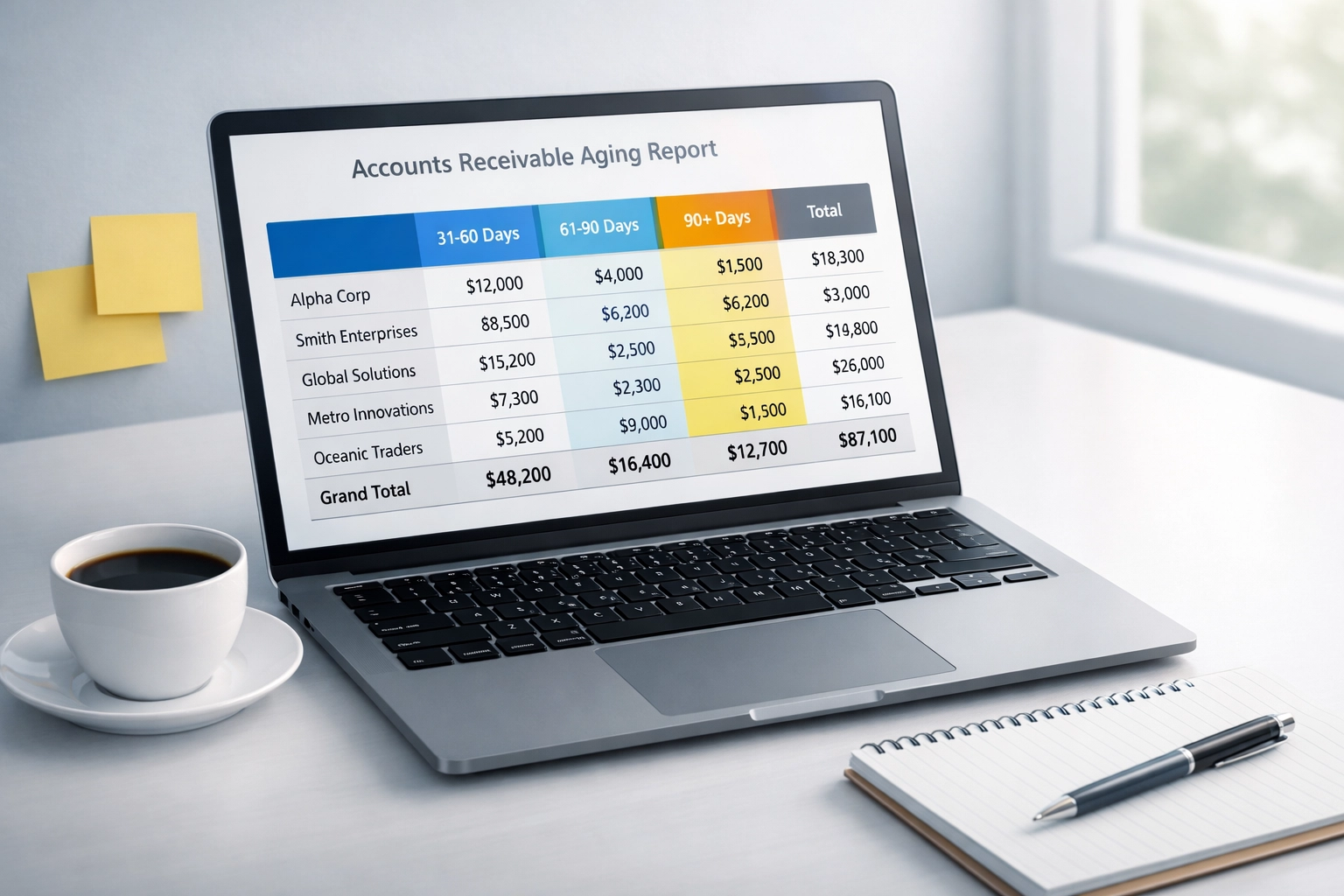
The format is straightforward. Each customer gets a row showing their name, total balance due, and how that balance breaks down across aging categories. A construction contractor might see that Client A owes $15,000: but $12,000 of that is 60+ days overdue. That’s a problem invoice hiding in a seemingly healthy receivables balance.
The report typically includes:
- Customer contact information and account details
- Individual invoice numbers and issue dates
- Amount due for each invoice
- Days outstanding for each invoice
- Subtotals for each aging category
- Grand total of all receivables
Most accounting software generates this report automatically. QuickBooks, Xero, and FreshBooks all have built-in AR aging reports that update in real-time as you record payments and issue new invoices.
Why This Report Matters More Than Your P&L
Profit and loss statements show revenue when invoiced. Your AR aging report shows revenue when collected. That gap is where businesses suffocate.
A marketing agency might report $500,000 in annual revenue but struggle with payroll because 40% of that revenue sits in the 60+ days overdue column. The business looks profitable on paper while the owner drains personal savings to cover expenses.
The aging report exposes this reality before it becomes a crisis. It functions as an early warning system for three critical business risks.
Cash Flow Forecasting
Each aging category represents a probability of collection. Invoices in the current (0-30 days) bucket have a 95%+ collection rate. Invoices 60+ days overdue drop to 70% or lower. By analyzing your report monthly, you can project actual cash collections with reasonable accuracy.
This forecasting helps you make smarter decisions about hiring, equipment purchases, and taking on new projects. Instead of basing decisions on invoiced revenue, you base them on collectible revenue.
Credit Risk Identification
Some customers pay late occasionally due to processing delays. Others consistently pay 60-90 days late because they’re using you as a free line of credit. The aging report reveals the pattern.
A technology startup might notice that their largest client: accounting for 30% of total revenue: always pays 75+ days late. That concentration of slow-paying receivables represents existential risk. If that client stretches to 120 days or defaults entirely, the startup faces immediate financial distress.
Collection Prioritization
You can’t chase every overdue invoice with equal intensity. The aging report helps you focus collection efforts where they matter most. A $50,000 invoice at 75 days overdue demands immediate attention. A $500 invoice at 35 days can wait another week.
This prioritization protects relationships with good clients while applying appropriate pressure to problematic ones.

The Anatomy of a Healthy vs. Unhealthy Aging Report
Industry benchmarks vary, but general standards apply across most service businesses. A healthy AR aging report shows:
Current (0-30 days): 60-75% of total receivables
This is money you’ve recently invoiced and reasonably expect to collect within normal payment terms. If this percentage is lower, you’re either not invoicing frequently enough or your collection cycle is broken.
31-60 days: 15-25% of total receivables
Some delay is normal, especially with larger corporate clients who have rigid payment processing schedules. This bucket should contain invoices that are slightly overdue but not yet concerning.
61-90 days: 5-10% of total receivables
These invoices require active collection efforts. A polite follow-up call, a second notice, or a conversation with the client’s accounts payable department. This aging category represents money at risk.
90+ days: Less than 5% of total receivables
Anything in this category has a collection rate below 50%. These are problem invoices that may require formal demand letters, collection agencies, or writing off as bad debt. A high percentage here signals serious cash flow problems.
Red Flags That Demand Immediate Action
Certain patterns in your aging report indicate systemic problems that require immediate intervention.
The Concentration Risk Pattern
One or two customers representing more than 30% of your total receivables creates dangerous dependency. If those customers slow their payments or default, your entire business is at risk. Small business bookkeeping services often see this with contractors who have one large general contractor client.
The solution involves diversifying your client base and implementing stricter payment terms with high-concentration clients. Net 15 instead of net 30. Deposits required upfront. Progress billing instead of payment upon completion.
The Consistent Slow-Pay Pattern
Some customers appear on every aging report with balances in the 60-90 day category. They pay eventually, but always late. This pattern indicates they’re using your receivables as working capital for their business.
These clients cost you money through reduced cash flow and increased administrative burden. The relationship needs restructuring: shorter payment terms, deposits, or pricing that reflects the true cost of extended payment cycles.
The Growing Older Categories
If your 60+ day receivables are growing month-over-month, you have a collection problem. Either your invoicing process has gaps, your payment terms are too loose, or you’re not following up on overdue accounts aggressively enough.
This trend demands immediate process changes. Automated payment reminders, stricter credit policies, or bringing in outsourced bookkeeping services to handle collections more systematically.
Turning Your AR Aging Report Into Action
The report only creates value if you use it consistently. Most successful businesses follow a monthly review process.
Step 1: Generate the Report on the Same Day Each Month
Consistency matters. Generate your AR aging report on the first business day of each month. This creates comparable data points and ensures you’re tracking trends accurately. Reports generated at random intervals make it harder to spot concerning patterns.
Step 2: Calculate Your Average Collection Period
Add up your total receivables and divide by your average daily credit sales. This tells you how many days, on average, it takes to collect payment. Industry standards vary, but 45-60 days is typical for B2B service businesses.
If your average collection period is growing month-over-month, your payment terms or collection processes need immediate attention.
Step 3: Review the 60+ Day Category by Customer
Every invoice older than 60 days gets a personal follow-up. Call the client directly. Ask if there’s an issue with the work, a problem with the invoice, or a payment processing delay. Often, overdue invoices result from simple administrative issues: an invoice went to the wrong email, a contact changed roles, or the client’s AP system flagged something for review.
These calls often resolve issues immediately and preserve client relationships better than aggressive collection letters.
Step 4: Adjust Credit Terms for Repeat Offenders
Clients who consistently appear in the 60+ day category need modified payment arrangements. Require deposits before starting work. Implement progress billing for longer projects. Shorten payment terms from net 30 to net 15.
These adjustments protect your cash flow without severing the client relationship entirely.
Step 5: Build Bad Debt Reserves
Use your aging report to estimate uncollectible amounts. Invoices 90+ days overdue have roughly a 50% collection rate. Set aside reserves to absorb these potential losses without disrupting operations.
This practice is standard in accounting services Northern Virginia firms recommend for businesses with significant B2B receivables.
When to Bring in Professional Help
Most founders can manage AR aging reports effectively with basic accounting software. However, certain situations benefit from professional support.
Your receivables exceed $250,000
At this scale, collection management becomes a specialized function. A missed $50,000 invoice can create significant cash flow disruptions. Professional small business bookkeeping services can systematize collection processes and free up your time for higher-value activities.
You’re seeing consistent growth in older categories
If your 60+ day receivables are growing despite your collection efforts, you likely have process gaps. An experienced bookkeeper can identify where invoices are falling through cracks and implement systematic follow-up procedures.
Your industry has complex billing requirements
Construction, healthcare, and government contracting often involve progress billing, retainage, and elaborate payment terms. These complexities make AR management significantly more challenging. Specialized accounting support ensures nothing gets missed.
You’re spending 10+ hours monthly on collections
Your time has value. If AR management is consuming substantial founder time, outsourcing to professional bookkeeping services often pays for itself through improved collection rates and freed-up capacity.
Making the Report Part of Your Monthly Rhythm
The AR aging report works best as part of a consistent financial review process. Pair it with your cash flow statement and P&L to get a complete picture of business health.
Set a recurring calendar event for the first Monday of each month. Generate your AR aging report, review the 60+ day category, and make any necessary collection calls that same day. This monthly discipline prevents small issues from becoming major cash crises.
Track your average collection period month-over-month. Improving this metric by just 10 days can free up significant working capital without changing anything else about your business.
Most importantly, use the report proactively rather than reactively. Don’t wait until you can’t make payroll to start aggressive collection efforts. By then, you’re already behind.
The Bottom Line on AR Management
Your receivables represent real money, but only if you collect them. The AR aging report transforms vague hope about future payments into concrete data about collection probability and timing.
This single document helps you forecast cash flow accurately, identify problematic client relationships before they become dangerous, and focus collection efforts where they’ll have the greatest impact. Businesses that master AR aging report analysis consistently maintain healthier cash positions than competitors with identical revenue but poor collection discipline.
The difference between thriving and struggling often comes down to this unglamorous report and the discipline to act on what it reveals. Your invoiced revenue means nothing until it clears your bank account. The AR aging report is your roadmap for making that happen consistently.
If your aging report consistently shows warning signs: high concentration risk, growing older categories, or average collection periods exceeding 60 days: consider reaching out to professional accounting services for a review. Sometimes an outside perspective identifies gaps that are invisible when you’re deep in daily operations. The goal is turning those paper profits into actual cash you can deploy to grow your business.


